
12 Questions to Ask a Pink Salt Exporter Before You Place an Order
Most problems with imported pink salt are decided before the order is placed — in the conversation, not in the container. A shipment that arrives with the wrong grain, weak packaging or missing paperwork is usually the result of questions that were never asked, or answers that were never pinned down in writing. The exporter cannot guess your market’s requirements, and you cannot inspect a warehouse on another continent from your desk.
That is why a good question list protects both sides. The exporter gets a clear specification to work to; you get answers you can compare between suppliers and hold the chosen one to. The twelve questions below are the ones experienced importers ask before any money moves. Grouped by product, quality, packaging and terms, they will tell you very quickly whether you are dealing with a business that works to a specification — or one that simply works to a price. If you are still at the stage of comparing suppliers, our guide on how to choose a bulk pink salt supplier covers the wider checks; this article is about the exact conversation to have with the exporter you are about to order from.
About the product
1. Which grades do you supply, and how is each one defined?
“Pink salt” is a family of products, not a single one, and grade names only mean something if the definition behind them is clear. At Teranexa Trader we supply six edible grades — fine, extra fine, coarse, crystals, powder and granules — but the names alone are not the point. A good answer explains what distinguishes each grade in practical terms: the grain character, the uses it suits, and how it differs from the grade above and below it. An exporter who can only repeat the grade names back to you probably cannot match a grade to your product.
2. How is the grade confirmed for my order?
Descriptions in a chat message are not confirmation. Ask what mechanism ties your order to a specific grade: a written product description in the quotation, a retained reference sample, a specification agreed before packing. A good answer names a concrete step — at Teranexa Trader, the grade specification is confirmed in writing as part of the order process, before anything is packed. What you want to hear is a process, not an assurance.
3. Can I see the specification in writing before payment?
This follows naturally from the previous question, and it is the one that separates careful exporters from casual ones. If the full order — product, grade, quantity, packaging and destination — can be set out in a written quotation before you pay, both sides are protected. A good answer is simply “yes, here it is”, followed by a document you can file. Hesitation at this stage, or pressure to pay first and receive paperwork later, is information you should take seriously.
About quality
4. How do you check consistency between orders?
Your first shipment may be excellent and your third disappointing if nothing checks one order against the next. Ask what is actually compared: grain against the agreed description, appearance from batch to batch, the packing standard. At Teranexa Trader, the quality process runs in four steps — the specification is agreed, the grain is checked, consistency is checked, and the packing is checked before dispatch (you can read more on our Quality Control page). A good answer from any exporter describes repeatable checks, in the same order, on every shipment — not a one-off inspection performed because you asked.
5. What happens if a shipment differs from the agreed specification?
Ask this while relations are friendly, because it is much harder to ask afterwards. A serious exporter will not be offended; they will explain how a difference would be established — against the written specification and any retained reference — and what they would do next. A good answer is calm, specific and refers back to the agreed documents. An exporter who insists the question is unnecessary because problems “never happen” is telling you there is no process for when they do.

About packaging and logistics
6. What packaging suits my route?
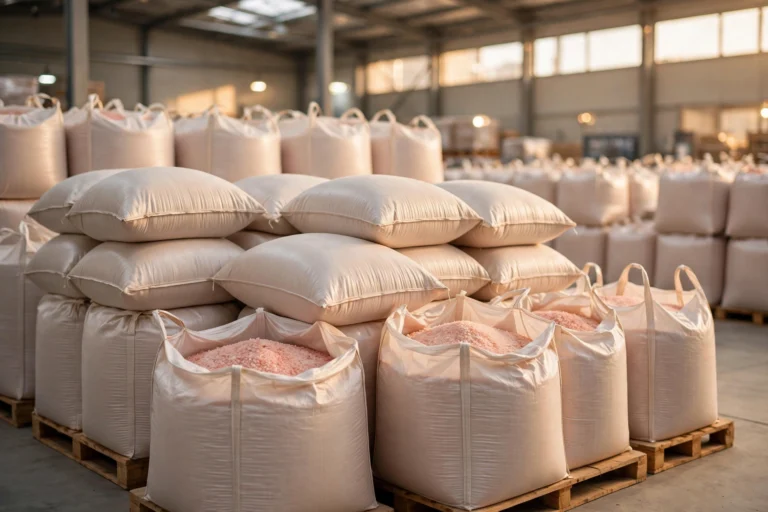
Salt is heavy, and it absorbs moisture from the air. Packaging that survives a short domestic journey can fail on a long sea route or in humid storage, arriving as solid blocks instead of a free-flowing product. Ask the exporter to recommend packaging against your actual route, destination climate and how you will store and use the product — and to explain the reasoning. A good answer asks questions back about your journey and handling; a poor one offers a single standard pack for every destination on earth.
7. What is agreed before dispatch?
Surprises at dispatch usually come from details nobody confirmed: how the goods are packed, how they are marked, what the final packed quantity is, and when the order leaves. Ask for the dispatch details to be confirmed as part of your written order, so what you approved is what travels. A good answer treats this as routine — the packing is checked against what was agreed before the order goes out. If everything is left to “we will manage”, nothing is actually managed.
8. Which documents will I receive with my shipment?
Your shipment does not end at the port; it has to clear your market’s import process, and missing or mismatched paperwork is one of the most common and most avoidable causes of delay. Ask the exporter which documents they will provide, in what names and details they will be issued, and what your side must supply for them to be prepared correctly. A good answer lists the documents plainly and asks for your requirements early. Export documentation is handled as part of the order at Teranexa Trader and confirmed with your quotation, as described on our page for buyers importing from a pink salt exporter in Pakistan.
About the business and the terms
9. Who will handle my order, and how do I reach them?
When something needs an answer quickly, “the sales team” is not an answer. Ask for a named person responsible for your order and a direct way to reach them. At Teranexa Trader, enquiries are handled by named management — Muhammad Aslam (CEO) and Ahmad Sufyan Warsi (CMO) — whose direct phone numbers are published on this website. A good answer gives you a person, not a department, and that person stays reachable after payment, not only before it.
10. How is pricing calculated for my order?
You are not asking for a secret formula; you are asking what the price is built from — grade, quantity, packaging and destination all change the cost of fulfilling an order, and a price that ignores them is not a real price. A good answer explains the variables and then gives you a figure for your exact requirement in a written quotation. At Teranexa Trader, that is the only way pricing works: no generic lists, because a price quoted without your specification cannot be honoured reliably.
11. Can I request a sample, and on what terms?
A sample lets you check the grade against your product and your market before committing to volume, so always ask — but ask about the terms in the same breath. Quantity, cost and carriage should be stated before anything is sent, so neither side is surprised. A good answer confirms the terms in writing first; at Teranexa Trader, sample availability and terms are confirmed per request in exactly that way. Treat a sample as a reference for the specification conversation, not as a substitute for it.
12. What should I confirm before the order is final?
Finish by summarising the order back to the exporter: grade and its definition, quantity, packaging, destination, the documents to be provided, and the price as quoted. Ask explicitly whether anything in that summary is not agreed. A good exporter will correct the summary where it is wrong and confirm it where it is right — and that confirmed summary becomes the reference both sides work to. Five minutes on this step prevents most of the disputes that buyers and exporters ever have.

Red-flag answers to watch for
The questions matter, but so do the patterns in how they are answered. Watch for: prices quoted instantly without asking your grade, quantity or destination; grade names with no definition behind them; paperwork promised “after payment”; quality described only with adjectives — premium, pure, best — and never with a process; documents discussed vaguely or dismissed as unimportant; and a business you cannot attach to a named person, a real address and a reachable phone number. None of these proves dishonesty on its own, but together they describe a transaction built on trust alone, with nothing written down. Trade across borders runs on what is written down.
One more pattern deserves a mention: the exporter who agrees to everything. Every grade, every packaging format, every term, confirmed without a single question back. Real supply has edges — grades that suit your use and grades that do not, packaging that fits your route and packaging that does not. An exporter who tells you honestly that something falls outside what they can supply is showing you the same honesty you will rely on when your order is being packed.
Still Looking for the Right Supplier? You Can Stop Here.
If you have been comparing suppliers and nobody has given you straight answers, that is exactly the gap Teranexa Trader fills. Tell us what you need — the grade, the quantity, the packaging and the destination — and we supply to your demand: your specification is confirmed in writing first, and then you receive a quotation for your exact order. No generic price lists, no vague promises, and no anonymous sales desk.
- Supply matched to your specification — grade, grain, packaging and destination
- Written quotation before anything is packed or shipped
- Six edible Himalayan pink salt grades from one supplier in Pakistan
- Named management you deal with directly — Muhammad Aslam (CEO) and Ahmad Sufyan Warsi (CMO)
FAQs
Do I need to ask all twelve questions for a small first order?
Yes — a small first order is exactly where the answers matter most, because it sets the specification every later order will be compared against. The questions scale down easily; even a short written exchange that confirms grade, packaging and terms gives you a reference for the next order.
What if an exporter will not put the specification in writing?
Then you do not have a specification — you have a conversation. Most misunderstandings in bulk buying come from that gap. Either the exporter confirms the order details in writing, or you should understand clearly that you are buying on trust alone and decide whether that risk is acceptable.
Should I choose the exporter with the lowest price?
Only after the answers are equal. Two quotations are comparable solely when grade, quantity, packaging and destination match. The cheapest quote against a loose specification often becomes the most expensive order once the wrong grade arrives.
How long should asking these questions take?
One focused exchange — a single email or call, followed by written confirmation. If clear answers take weeks of chasing, that is itself an answer about how your order will be handled.
Ask us these questions
This list was written to be used — including on us. Teranexa Trader is a B2B supplier of edible Himalayan pink salt based in Hasilpur, Punjab, Pakistan, and every order here is confirmed in a written quotation before anything is packed. Read how we check quality on our Quality Control page, see how export orders work on our Pink Salt Exporter from Pakistan page, then request a quotation with your grade, quantity, packaging and destination — and put all twelve questions to us with it. The same questions apply to fresh mangoes in season — variety instead of grade — and our quote form has a mixed order option for salt and mangoes together.